Most people don't think about safety when they book a drainage job. The contractor turns up, fixes the drain, and leaves.
But drainage work involves more risk than almost any other domestic service, including biological contamination, toxic gases, confined-space entry, and heavy equipment used in tight spaces. The way a contractor manages those risks is what separates a professional drainage service in London from a cheap one that could leave you, your family, or your tenants exposed.
This guide explains what proper drainage safety looks like in practice — the risk assessments, PPE, confined-space controls, and regulations that should apply to any drainage job on your property. It's not a technical manual. It's what you should expect to see, and what to question if you don't.
Why Drainage Work Has Safety Risks Most Homeowners Don't Realise
Drainage work isn't dangerous in an obvious way. There are no flames or live electricity. The hazards are quieter and more specific.
Wastewater carries pathogens E. coli, Weil's disease (leptospirosis from rat urine), and gastrointestinal infections that can affect anyone who comes into contact with it. Sewer gas, particularly hydrogen sulphide and methane, can build up in confined drainage chambers and become toxic or even explosive at the wrong concentration.
High-pressure jetting equipment, used incorrectly, can cause serious injury. Older drainage chambers in London properties may be deeper, narrower, or in worse structural condition than the operator expects.
A trained drainage team plans for all of this before they arrive. An untrained one improvises on the day, and improvisation is where accidents happen — to workers, to occupants, and sometimes to the property itself.
What a Proper Risk Assessment Should Cover Before Work Starts
A risk assessment is the first piece of safety work, and it should be done before any tools come out of the van.
A competent contractor checks the site, the equipment they'll be using, and the specific drainage process before starting. They identify slip, trip, and fall hazards on access routes. They check whether wastewater, chemicals, or contaminated debris are likely. They confirm equipment is in good working order; faulty jetters, damaged hoses, or worn PPE go back to the depot, not into use. And they put preventive controls in place: training, planned maintenance, signage, and restricted-access zones around the work area.
For larger jobs, this assessment is documented. For routine work, it should still happen visibly; even a quick walk-around tells you the contractor is thinking about safety. A CCTV drain survey before any major repair is part of this same picture: it confirms what's actually in the pipework before anyone has to work on it.
Safety Protocols a Drainage Team Should Follow on Site
Once the assessment is done, the protocols kick in. These are the standing rules a competent crew works to.
Equipment is operated according to manufacturer guidance and the operator's training, particularly important for high-pressure jetters, which can cause serious injury at the wrong pressure or angle. Hazardous materials are handled with the right procedures: proper containment of wastewater, safe disposal of contaminated debris, and controlled use of any chemicals through licensed waste routes.
Emergency response plans cover what to do if there's an accident, a chemical leak, an injury, or an unexpected hazard like a previously undetected gas pocket. Work areas are physically controlled barriers, signage, and clear instructions to keep occupants away from active drainage work and unsafe surfaces.
And before any major work, the team explains what will happen, where the hazards are, and which areas of the property to stay clear of. This last point is that clear communication is one of the easiest ways to spot a professional crew. They tell you what's happening before they do it.
For drain repairs specifically, this matters even more because excavation, relining, and patch repairs all carry different risks that the team should explain in plain language.
Personal Protective Equipment: What You Should See on a Drainage Crew
PPE is the most visible part of drainage safety. If a crew arrives in casual clothes and starts opening chambers, that's a warning sign on its own.
PPE for above-ground drainage work
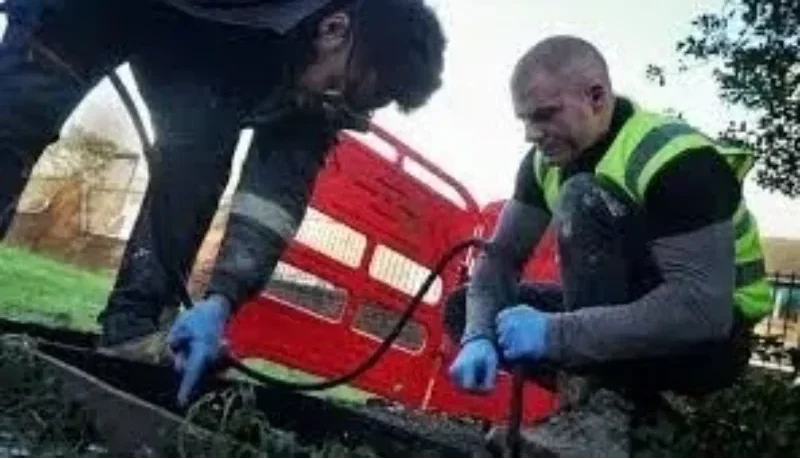
For routine above-ground work, a competent operator wears chemical-resistant gloves to protect against contamination from wastewater and any cleaning agents in use. Safety goggles shield the eyes from splashes, particularly during jetting, which can spray contaminated water at high force. High-visibility clothing keeps the worker visible to traffic and to the property occupants. Steel-toe boots protect feet around heavy equipment.
Hard hats are standard on most jobs and essential where there's any risk of falling debris, such as work near buildings, scaffolding, or in older drainage chambers where masonry can dislodge.
PPE for confined-space and below-ground work
This is where PPE becomes much more involved. A worker entering a confined drainage chamber needs everything above plus an FFP3 respirator or, for higher-risk environments, a full breathing apparatus. They need a personal gas detector to monitor oxygen levels, hydrogen sulphide, methane, and carbon monoxide in real time. They need a harness and rescue line attached to a tripod and winch system at the entry point, with a trained colleague topside ready to extract them if anything goes wrong.
If you see a worker climbing into a chamber without any of this, particularly without a gas detector or rescue line, that's not a competent confined-space entry. It's a serious safety failure.
Confined-Space Safety in Drainage: The Hidden Hazard
Many drainage tasks involve entering chambers, manholes, or other tight enclosed spaces. The Confined Spaces Regulations 1997 govern this work in the UK, and the requirements are strict for good reason; confined-space incidents account for a disproportionate share of drainage industry fatalities.
The legal requirements for confined-space entry
Before any confined-space entry, a full risk assessment must identify the hazards: toxic gases, oxygen deficiency, the risk of being trapped or overwhelmed by liquid or debris, and the structural condition of the chamber itself.
Effective ventilation must be set up to clear dangerous gases and replenish oxygen. The right PPE for the specific conditions must be in use; generic gloves and goggles aren't enough for confined-space work. And the worker entering must be trained in safe entry procedures, hazard recognition, and emergency response. Untrained operatives entering confined spaces is illegal under UK law.
Emergency protocols for confined-space incidents
The plan for what happens if something goes wrong matters as much as the plan for the work itself. Clear evacuation routes and communication methods between the workers inside and the team outside are essential. Rescue equipment, extraction harnesses, breathing apparatus, and first-aid supplies must be on site, not back at the depot. Trained personnel must be ready to respond, and regular drills keep that readiness current.
For most homeowners, the key point is simple: if a contractor is going to enter a chamber on your property, you should see a tripod, a harness, a gas detector, and at least two operatives on site. If you only see one person climbing in alone, the job isn't being done safely.
UK Drainage Safety Regulations and What They Mean for Your Property
UK drainage work sits inside a layered regulatory framework. The Health and Safety at Work Act 1974 sets the overall duty of care. COSHH (Control of Substances Hazardous to Health) covers the contaminants that drainage workers are exposed to. The Personal Protective Equipment at Work Regulations require employers to provide and maintain appropriate PPE. RIDDOR governs the reporting of work-related accidents and dangerous occurrences.
Local site requirements add a further layer, particularly on commercial or shared properties, where building managers, insurance providers, or local authorities may have additional standards.
In practice, what this means for property owners is that any contractor working on your drainage should be able to evidence compliance: documented risk assessments, properly maintained PPE, accident reporting procedures, and equipment inspection records. If a contractor can't or won't show you any of this, they're working outside the regulatory framework that exists to protect both their workers and your property.
What Safety Looks Like in an Emergency Drainage Call-Out
Emergencies are where safety standards are tested hardest. A flooded basement, a sewage backup, or a collapsed drain creates pressure to act quickly and that pressure is exactly when shortcuts get taken.
A professional emergency drain service doesn't skip the assessment. The crew arrives, contains the immediate hazard (stopping further water ingress, isolating contaminated areas), then carries out the same risk-based approach as a planned job, just compressed in time. PPE goes on before they enter the affected area.
The work area is controlled to keep occupants away from contaminated water. Once the immediate emergency is handled, the underlying problem is properly diagnosed, often with a CCTV survey, before any repair decisions are made.
Speed matters in an emergency. But speed without safety creates worse problems is a contaminated property, an injured worker, or a botched repair that has to be redone.
What Safe Communication With the Client Should Look Like
Good safety practice includes you, the client. Before work begins, a competent crew explains what they'll be doing, where the active work area is, which parts of your property to stay clear of, and how long the disruption will last. Children and pets need to be kept away from contaminated water and equipment until the area is decontaminated.
If something changes during the job a different scope, an unexpected hazard, a need to extend the work, the crew should tell you, not just press on. Visible signage marks restricted zones. Anyone on the property knows what's happening and why.
Environ Drainage Services treats client communication as part of safety, not a separate customer-service activity. You should know what's going on at every stage.
Red Flags That Suggest a Drainage Contractor Isn't Working Safely
Some warning signs are obvious. A crew without PPE. Casual clothes around contaminated water. One person is entering a chamber alone. No visible signage or barriers around the work area. No risk discussion before the tools come out.
Other red flags are subtler. A contractor who can't explain confined-space procedures when asked. No company name on vehicles or paperwork. No evidence of accreditation (SafeContractor, CHAS, Constructionline, NADC). Quotes given without any inspection. Work was carried out without a CCTV survey or any documentation of what was found.
Cheap quotes are often cheap because the safety budget has been cut. The contractor who carries proper PPE, runs gas monitors, and works in pairs costs more for a reason and that reason is that nothing on your property gets damaged, contaminated, or worse.
Frequently Asked Questions
Is it safe for me to be at home while drainage work is being done?
Yes, in most cases. Routine drainage work happens outside the living space, and a competent crew will tell you which areas to avoid while they're working. For more invasive work, major excavation, sewage cleanup, confined-space entry near the property, the crew may ask you to keep a specific area clear or to keep children and pets indoors. They should always tell you in advance.
Can sewer gas from drainage work make me ill?
It can if a chamber is opened in or near the property without ventilation. Hydrogen sulphide and methane in concentrated form are dangerous. A professional crew uses gas monitors and ventilates chambers before and during entry, which prevents gas from building up where it could affect occupants. If you smell rotten eggs or a strong sewer odour during work, tell the crew immediately.
What should a drainage company show me before starting work on my property?
A clear risk assessment for the job, evidence of insurance (public liability and employer's liability), accreditation references (NADC, SafeContractor, Constructionline, or similar), and a brief explanation of the work, the hazards, and the areas you should avoid. Reputable contractors offer this information without being asked.
Why do I sometimes see two drainage workers when only one is doing the work?
Confined-space entry legally requires a second person topside as a safety watch and rescue contact. Even when the chamber looks shallow or simple, a single operator entering alone is non-compliant under UK regulations. If you see two workers and only one is in the chamber, that's the rule being followed properly.
What happens if a worker has an accident on my property?
Reputable drainage companies carry employer's liability insurance covering their workers, and public liability insurance covering damage to your property. Accidents are reported under RIDDOR where applicable. You shouldn't be liable for a worker's injury caused by their own work, but if a contractor isn't insured, that protection breaks down. Always confirm insurance before booking.
How do I report a drainage company that's working unsafely?
Serious safety failures can be reported to the Health and Safety Executive (HSE). Less severe issues can go to the relevant accreditation body, NADC, SafeContractor, or whichever scheme the company belongs to. You can also leave honest reviews on Trustpilot, Google, or Which? Trusted Trader. Genuine safety concerns shouldn't be ignored, particularly if children or vulnerable occupants were exposed.